 samexim
In every Indian kitchen, there’s a secret ingredient that ties flavors, aromas, and emotions together — Masala. Whether it’s the rich warmth of garam masala in a curry or the tangy kick of chaat masala sprinkled on fruit, masala lies at the heart of Indian cooking. But what exactly is masala, how many different types of masala exist, and why are Indian masalas so celebrated around the world?
Let’s explore this flavorful journey through the world of Indian spices, their traditions, and their irresistible charm.
The word Masala (मसाला / مسالہ) simply means a “blend of spices.” But in India, its meaning goes beyond the literal. It represents a balance of taste, aroma, and culture.
In most Indian homes, “masala” can refer to anything from a dry spice powder, a wet paste, or even a flavor base used in curries, marinades, or snacks. When someone says, “make the masala first,” it often means preparing the base of onions, tomatoes, and spices before adding the main ingredients.
Masala is not just about taste — it’s about memory, tradition, and family recipes passed down for generations. Each region, and often each household, has its own unique version of the same masala, adjusted to personal preference and local ingredients.
Masala brings magic to a dish. Its role goes far beyond flavor — it defines the entire character of the food.
In short, masala is the foundation of Indian food, and mastering it means understanding the balance of spices and their purpose in each dish.
While there are endless varieties, masalas can be broadly classified into four major categories — dry, wet, whole (khada), and regional masalas.
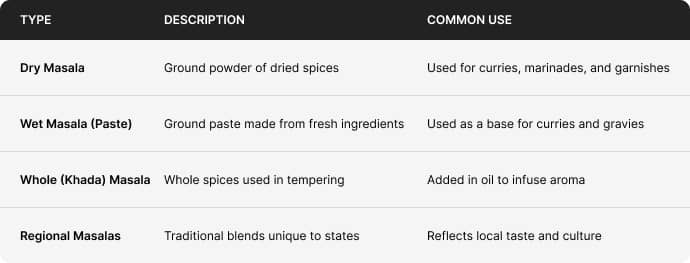
Let’s understand each in detail.
Dry masalas are the most common and convenient form of spice blends. They’re easy to store, sprinkle, and mix into dishes. A few popular examples include:
Dry masalas are the most common and convenient form of spice blends. They’re easy to store, sprinkle, and mix into dishes. A few popular examples include:
Wet masalas combine fresh and dry ingredients to create a paste used as the base of many gravies.
Common wet masalas include:
Wet masalas are usually sautéed in oil until aromatic and form the foundation for curries like paneer butter masala, chicken korma, or dal tadka.
Whole masala refers to unground spices used at the start of cooking to flavor the oil.
Common combinations include:
Whole masala refers to unground spices used at the start of cooking to flavor the oil.
Each state in India has its own unique spice mix that defines its cuisine:
Each blend reflects local spices, climate, and culture, giving every Indian meal a distinct regional identity.
Let’s look at the most popular and essential masalas found in almost every Indian kitchen:
Every region has its own variation of garam masala, from the North’s intense version to the South’s lighter, sweeter version.
Meaning: “Hot spice mix” — though it refers to warmth, not spiciness.
Ingredients: Cumin, coriander, cardamom, cloves, cinnamon, nutmeg, and bay leaf.
Use: Added toward the end of cooking to enhance aroma and flavor.
The secret behind its appeal is kala namak (black salt), which gives it that irresistible street-food flavor.
Flavor: Tangy, spicy, and slightly smoky.
Ingredients: Dried mango powder (amchur), black salt, cumin, coriander, and red chili.
Use: Perfect for fruit salads, chaats, fried snacks, and raita.
Different regions — Hyderabadi, Lucknowi, or Malabar — all have their own distinct biryani masala recipes.
Purpose: Used to flavor rice and meat in biryani dishes.
Ingredients: Cinnamon, star anise, nutmeg, mace, bay leaf, cardamom, and pepper.
Use: Mixed with marinated meat or vegetables and layered in rice for dum-style biryanis.
Origin: Mumbai street food.
Flavor: Strong, tangy, and slightly smoky.
Ingredients: Coriander, cumin, chili, fennel, and dried mango powder.
Use: Stirred into mashed vegetables while making pav bhaji.
This masala also enhances other street foods like tawa pulao and masala dosa.
Purpose: For chickpea or kidney bean curries.
Ingredients: Cumin, coriander, amchur, cinnamon, black cardamom, and cloves.
Use: Builds a thick, flavorful gravy with tomato and onion base.
Each northern Indian household has its own version of this masala, customized by family taste.
Region: South India.
Ingredients: Coriander, cumin, fenugreek, mustard seeds, red chili, and toor dal.
Use: Added to sambar, rasam, and other lentil-based dishes.
The combination of lentils and spices gives South Indian food its signature balance of tangy and spicy flavors.
Origin: Coastal Maharashtra and Goa.
Flavor: Deep, spicy, and slightly coconutty.
Ingredients: Dry red chilies, coriander, coconut, cumin, and peppercorns.
Use: Ideal for seafood curries and chicken gravies.
Specialty: Uses mild Kashmiri red chilies for color, not heat.
Ingredients: Fennel, clove, cinnamon, cardamom, and saffron.
Use: Common in Rogan Josh, Yakhni, and other rich Kashmiri dishes.
Masala is more than just a spice blend — it’s the heartbeat of Indian cuisine. From Kashmir’s saffron-laced gravies to Kerala’s coconut-infused curries, every dish tells a story through its masala.
Understanding what masala is, the different types of masala, and the popular Indian masalas gives a glimpse into India’s rich culinary diversity. Whether homemade or store-bought, each blend represents centuries of culture, tradition, and taste.
So next time you cook, remember — the magic lies not in the recipe, but in the masala
GF-8, Shayaan Homes, In Afrin Park, Bh. Canal, Fatehwadi, Ahmedabad-380055, Gujarat, India
+91 99243 98111 | +917383411592 info@samexim.in | samexim4@gmail.com© 2026 Sam Exim, All right reserved
“B2B success comes when you solve a problem before selling a solution.”